Bangkok,August 28,2026…Thammasak Sethaudom, President and CEO of SCG, shares his perspective in a Q&A with Chinese students on career mobility, the emerging role of AI Transformers, working alongside AI agents, and the enduring importance of continuous learning and learning discipline.
Under the concept of the “Organization of Possibilities,” SCG is committed to fostering continuous learning and capability development for the younger generation, who will serve as key drivers of future economic and social growth.
This commitment led to the inauguration of the “China Excellent Internship Program 2026 (CEIP 2026).” The program offers high-potential Thai and Chinese students first-hand experience at a leading enterprise, guided closely by industry experts and mentors. Over the two-month internship, participants honed essential future ready skills including business administration, management, and executive presentation alongside cultural exchange activities designed to prepare them for global careers.
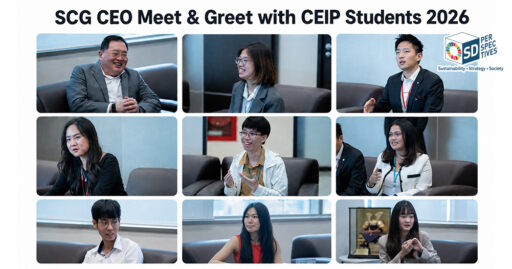
Marking the conclusion of the program, remaining CEIP 2026 interns gathered for an exclusive, informal farewell conversation with SCG’s CEO on the 22nd floor of the SCG 100th Anniversary Building.
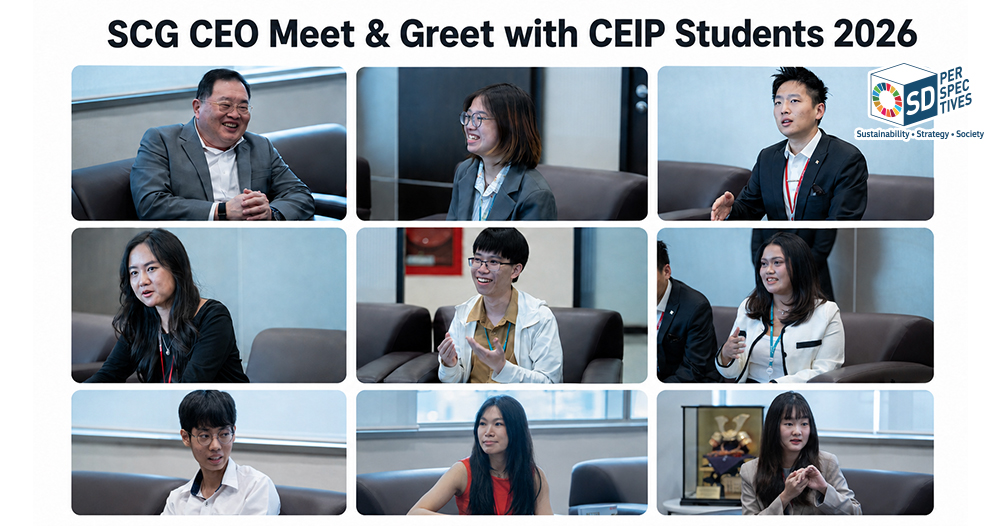
As artificial intelligence transforms industries and redraws the boundaries of work, young people are asking a critical question: What should they learn today to remain relevant tomorrow?
During a conversation with Chinese students participating in an internship programme at SCG, Thammasak Sethaudom, President and CEO of SCG, addressed three questions about career choices, the future workplace and the values that have shaped his professional journey.
His message was clear: AI will eliminate some existing tasks, but it will also create new roles for people who can connect technology with business outcomes. In an environment where knowledge changes rapidly, the ability and discipline to keep learning may become more valuable than any single degree or technical skill.
If you were young again and starting your career at SCG, which department would you choose, and why?
CEIP 2026 : If you were your younger self and starting your career at SCG today, which department would you choose to work in, and why?
CEO: I believe you could start in any department at SCG because we offer opportunities for job rotation and career mobility.
I know a senior colleague who began her career as a secretary and later became the head of the hydrocarbon business in the chemicals division. Her journey demonstrates that where you start does not necessarily determine where you can go.
There is no fixed limit on how far you can progress at SCG. You may begin in a junior role, but if you are willing to learn and courageous enough to take on new challenges, you can navigate your own career path.
If I were to recommend one area for young people to study today, however, it would be AI. Learning about AI means more than simply knowing how to use an AI tool.
SCG is implementing AI, particularly physical AI and industrial robotics, in its manufacturing facilities. A conventional production line might require around 90 to 100 employees, while a highly automated line may need only four. This illustrates the scale at which certain existing jobs or tasks could be displaced.
That may sound frightening, especially for the younger generation. But what many people do not yet recognise is that AI and automation will also create new jobs. These systems require machine learning, maintenance and continuous upgrading.
AI changes extremely quickly. A system implemented today may need to be upgraded next month. If a company waits for three months, the technology it is using may already be outdated.
This is why we need people whom we call AI Transformers. They will work alongside professionals with deep AI capabilities in programming, data analytics and advanced mathematics.
Deep AI specialists may account for approximately 10–15% of the new roles, while AI Transformers could represent 40–50%. Over the next few years, we estimate that SCG may need around 2,000 people to perform AI Transformer roles.
They do not necessarily need to be highly specialised AI programmers. Their role is to reimagine processes, translate technological capabilities into practical applications and turn AI into measurable business results.
How is SCG preparing for a workplace in which people collaborate with AI agents?
CEIP 2026: Many large companies are developing AI agents to perform routine tasks or assist employees. They are also creating agent-to-agent workflows. In the future, instead of sending work directly to a colleague, we may send it to an AI agent and receive feedback through another agent. What is your view of this working environment, and how is SCG preparing for it?
CEO: We will definitely have to work with AI agents, and our ways of working will have to change.
In the future, one person may have five to ten AI agents working for them. These agents could operate 24 hours a day, seven days a week, and complete certain tasks ten or even 100 times faster than a person.
You could think of them as having several supermen or superwomen working for you. But even these highly capable agents will need performance assessments, training and regular upgrades because a more advanced agent may emerge every month.
When an agent fails to meet the required standard, an AI Facilitator may be needed to improve or replace it. Employees will manage multiple agents, use their outputs to support judgement and convert their work into business results.
Other teams may work behind the scenes on data models, cloud infrastructure, AI performance and cost management. AI will not necessarily be inexpensive, particularly as organisations use it at a greater scale.
SCG has already implemented AI across approximately 570 projects, generating an estimated THB 700 million in benefits. Most of these initiatives have been driven from the bottom up, allowing employees to identify ways to apply AI and improve productivity while measuring the benefits against the cost.
We have also approved a top-down AI transformation that will be implemented progressively over the coming decade. This will create different types of work—from using AI to generate revenue and redesign business processes to developing the underlying infrastructure and managing AI investment.
The future is not entirely negative. Existing jobs may decline, but new roles will also emerge. If the productivity gains generated by AI are greater than the jobs displaced, the resulting economic value could help offset some of the employment impact.
This is why we are pursuing what we call Responsible AI, which includes considering the consequences of AI adoption for employment and for the future of the younger generation.
Which value, practice or habit has contributed most to your career?
CEIP 2026: Could you identify a value that helped you build a successful career? What practice or habit has been the most useful and valuable throughout your professional journey?
CEO: The environment I entered more than 30 years ago was completely different from the one young people face today.
When I began my career, Thailand’s economy was growing by around 6% annually. Today, the country may be growing at approximately 2%, although other parts of ASEAN continue to offer stronger growth opportunities.
Young people cannot simply follow the same path I took because the conditions have changed. But one principle transcends time and circumstances: keep learning.
I graduated in electrical engineering and expected to work as an electrical engineer. Instead, my first position was as a cement production engineer, so I had to study cement technology.
I had spent four years studying electrical engineering, but then had to spend six months learning about cement production. After that, I moved into electrical maintenance, project work and eventually pursued an MBA through an SCG scholarship.
During my first MBA class, I could not understand what the professor was teaching. When I asked for help, he told me to study a foundational book first and then return to the subject.
After completing my MBA, I worked in information technology, moved into business development, worked in Vietnam, became a group CFO, led a business unit and eventually became CEO.
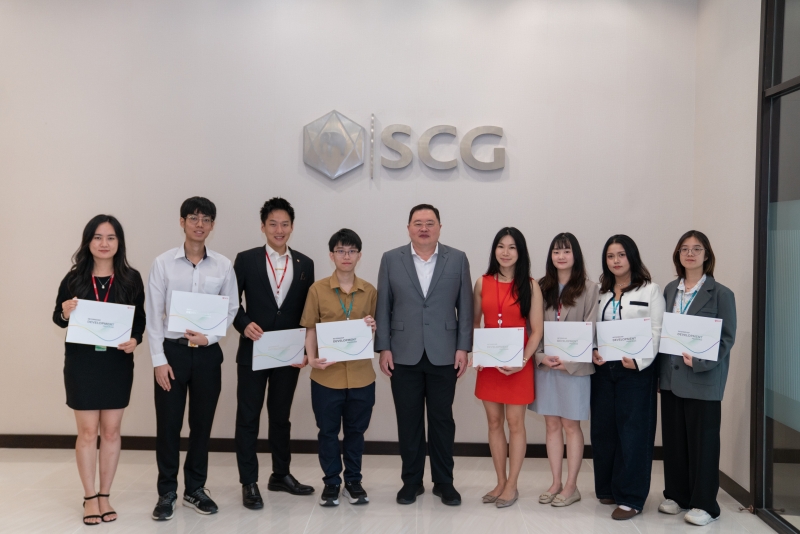
If I had stopped learning and insisted that, because I held an electrical engineering degree, I could only work as an electrical engineer, I would have become stuck. Continuous learning allowed me to grow into different roles.
The pace of change facing young people today may be ten times faster than what I experienced. The learning journey that took me 35 or 36 years may now need to be completed within ten years, perhaps with the help of AI.
In an AI-driven environment, the ability to learn will become even more important. Do not stop learning, and do not tell yourself, “I do not like this” or “I cannot learn this.” You can learn almost anything if you genuinely want to.
Another essential quality is learning discipline. People who become lifelong learners usually develop the discipline to learn consistently. Those who struggle to learn do not necessarily have a low IQ; they may simply lack a structured learning process.
Identify what you want to learn, establish a process and maintain the discipline to follow it. If you can do that, you can continue learning throughout your life.
Farewell : China Excellent Internship Program (CEIP)
SD Perspectives | Thailand’s Sustainability & Business Strategy Media
SD Perspectives delivers news and analysis on ESG, Nature & Biodiversity, Sustainable Finance, Business Strategy, and DEI—helping Thai leaders, investors, and organizations understand emerging risks, opportunities, and the changing direction of global business.