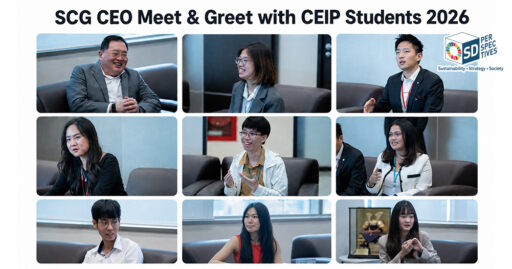
Bangkok, July 2 ,2026 – SCG has outlined its strategic plan to navigate an increasingly volatile global landscape marked by surging inflation, escalating geopolitical conflicts, intensifying regional competition, and rapidly evolving production technologies. These developments are propelling businesses toward “new rules of competition.” SCG emphasized that industries must urgently and flexibly adapt to enhance their competitiveness. This involves establishing interconnected production systems across the ASEAN region, accelerating the integration of Robotics and Artificial Intelligence (AI), enhancing workforce capabilities, and fostering collaboration throughout the entire business ecosystem. SCG remains confident that its short-, medium-, and long-term strategies will enable the company to capture growth opportunities, particularly within the ASEAN region, alongside emerging new prospects.
As the Business World “Evolves,”
Strategies Must “Change”
Thammasak Sethaudom, President and Chief Executive Officer of SCG, said that over the next three years, the industrial sector, particularly across ASEAN, will confront significant challenges arising from intensifying competition from the influx of manufacturers who possess cost advantages derived from a massive domestic market, supply chain vulnerabilities within the ASEAN region, high inflation rates, as well as the impacts of technological and climate changes. Together, these factors are fundamentally redefining the rules of competition in the ASEAN industrial landscape.
“Today, the industrial sector, particularly across ASEAN, stands at a crossroads. If we fail to act, we may see the decline of critical foundational industries, not only in Thailand but across ASEAN. One of the most evident risks SCG sees is intensifying competition from imported products, which are often more affordable. Amidst this changing industrial landscape, we must address how domestic and across ASEAN sectors can adapt to maintain ASEAN’s competitiveness,” said Thammasak.
ASEAN Emerges as a New Economic
Growth Hub Alongside China
SCG views that one of the crucial opportunities in today’s world lies within the ASEAN region, which is emerging as a strategic center for global economic connectivity and critical supply chains. This is driven by its immense potential in terms of population size, trade volume, and foreign direct investment. According to the latest report by the Asian Development Bank (ADB), the region’s GDP is projected to grow by an average of 4.7%*. Each ASEAN nation possesses distinct strengths that can complement one another, spanning innovation, cost-competitive production and export bases, supportive regulatory frameworks, and a highly capable workforce.
“When representatives from different countries convene, they often say that ASEAN is one of the world’s fastest-growing economic regions, with growth comparable to that of India and Africa. ASEAN also maintains a neutral position, enabling it to engage with all regions. Importantly, intra-ASEAN trade continues to expand at a steady pace. This presents a vital opportunity; if SCG can foster strong collaboration within ASEAN, we have the potential to become a self-reliant region,”
In addition, China stands as another major economic powerhouse and a valuable economic partner. SCG recognizes significant opportunities to forge strategic partnerships within this market to foster mutual growth.
“The growing presence of China in ASEAN presents both challenges and opportunities. SCG needs to strengthen itself by enhancing its competitiveness while welcoming new partners from China who can become strong business partners. If we can build strong business partnerships with China, we can create shared value. For example, ASEAN can serve as a manufacturing base for products destined for markets across the region, while some products can also be exported back to China and further expanded into other international markets,”
Short-, Medium-, and Long-Term Strategies
Strengthening Resilience to Capture Growth Opportunities
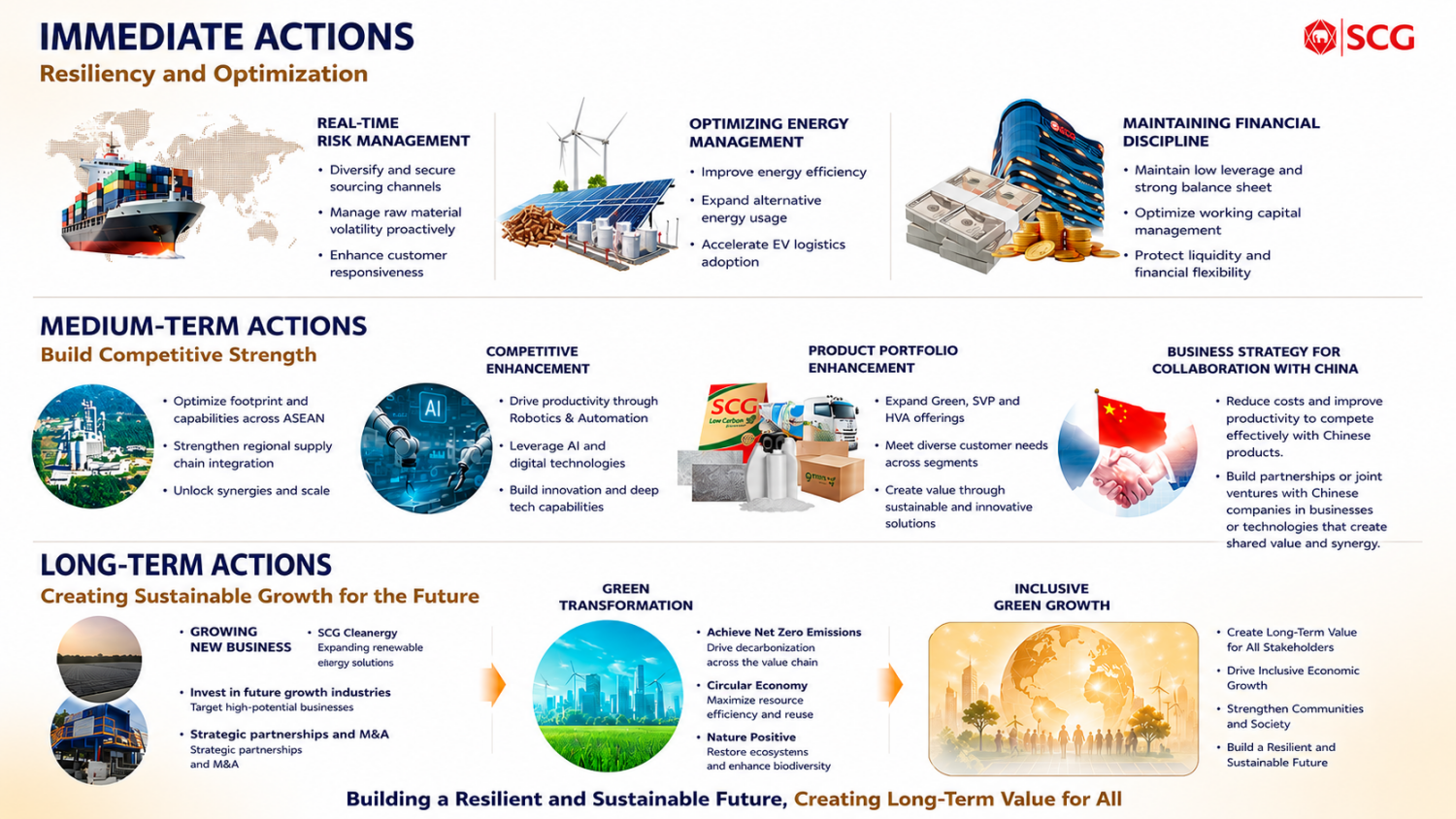
“In the immediate term, SCG’s execution must be agile and responsive in real time, as market conditions are changing every day. Another important point is maintaining financial strength because many businesses do not fail because they are unprofitable, but because they run out of cash. Over the next two years, we need to enhance our competitiveness to break through the constraints that currently limit us, so that our business can create greater opportunities and build greater strength. Looking three to five years ahead, we must establish new growth platforms, including expanding into clean energy and developing new S-curves, to create more avenues for SCG’s future growth.”
Technology and Talent Ready
Critical Drivers of Enterprise-Wide Transformation
SCG views technology, such as Robotics and AI, as a key variable capable of transforming every business process, from production and marketing to supply chain management and research and development. However, technology alone is not the definitive answer to achieving business success and enhancing competitiveness; rather, it is the people who harness these technologies effectively.
“Technology alone, including AI, does not deliver business results. SCG believes that AI technology must be driven by people. The greatest challenge, however, is helping employees recognize the opportunities it presents. This is crucial. Therefore, SCG’s positioning as an ‘Organization of Opportunities’ will serve as the most effective catalyst to accelerate this transformation,”
The President and Chief Executive Officer of SCG concluded by emphasizing that building competitiveness is not the sole mission of any single organization but rather a collaborative effort among all stakeholders within the business ecosystem to strengthen the capabilities of both the country and the region and enable shared growth.
“SCG cannot move forward alone. We must advance together with our entire supply chain, and not only within Thailand but across ASEAN. Thailand is fortunate to be part of ASEAN, a growing region that continues to attract strong interest from other nations and regions globally. However, if we do not collaborate and adapt swiftly, we risk falling into a trap of industrial decline, from which recovery would be exceedingly difficult.”
*Source: Asian Development Outlook, April 2026, Asian Development Bank (ADB).
SD Perspectives | Thailand’s Sustainability & Business Strategy Media
SD Perspectives delivers news and analysis on ESG, Nature & Biodiversity, Sustainable Finance, Business Strategy, and DEI—helping Thai leaders, investors, and organizations understand emerging risks, opportunities, and the changing direction of global business.